Tuesday, 13 March 2012

THAT graph

Anyone involved in the 'Workfare' debate has probably come across this graph.


Firstly, I make no attempt at claiming a bi-partisan position, I actively support the Schemes involved in 'Get Britain Working' policy but just like all positions that I hold, I like to do it with fact. I do not fear evidence in any way because I am not dogmatic and if I find evidence to suggest my view is wrong, I will simply change my view. If I say something that turns out to be incorrect, I will withdraw my comment.

 Now, with that said, let's review this graph and the text that accompanies it.

  “This [graph] appears to show that the youth work experience scheme has had no additional impact on the speed at which young people leave benefit, and may have actually led to them spending longer on benefit than they would have done.”

Now, as you can see, they are hinting at a lot and the creator of the graph has a lot to answer for. The table below shows the raw data


So we can see that the graph line for the Work Experience starts on weeks on scheme whereas the JSA line starts from start of claim.

This makes the two lines incomparable. As the Work Experience scheme is *primarily* for those between 13 and 39 weeks * Thanks to @consentmeuk for correcting me when I said at first that is was open to ONLY those of 3 months or more, whereas in truth, in exceptional circumstances the limit can be lowered and for 16/17 year olds the start of the scheme can be immediate. While this new information doesn't really change my point, I do like to make sure it is accurate.

A couple of points though, the activities in the scheme do not begin straight away, I do not know if they count the Start of Work Experience to mean the sign on date or the date the work placement begins.
At any rate, only if EVERY person who joined the Work Experience Scheme joined on the first day of their JSA and went straight into their Work Experience placement would we be able to compare the two lines and even then we would need to make some allowances.

Hopefully, you'll see now why comparing them is flawed, if not I will explain a little further.

Please note this document

In particular this line "Off-flows from JSA remain high - almost  60% of claimants leave within three months 
and almost 80% leave within six months of making their claim"

So, 60% of JSA claimants stop their claim before their even primarily eligible for the Work Experience, the numbers are higher for 16-24 year olds in fact, and at halfway through the primary eligible timescale (6 months) the number of people that have already stopped their claim goes up to 80% (again I believe this to be higher for <25 year olds.).

So lets look at that graph again..


Most people that take part in the Work Experience Scheme do not even appear on X axis. You would need to make it three times as long in fact to get all people who join the Work Experience scheme on it.

The reason most people go ON the Work Experience Scheme is because they haven't got the ability (Or luck yet) to get off benefits. This is evident as the people that primarily use the scheme are the 40% - 20% or lower that are still on JSA when they become eligible for volunteering for the programme.

It seems pretty harsh to compare the success rate for coming off 'out of work benefits' as a whole to that of a system that is designed for those that find it hard to get off 'out of work benefits' and then claim that the system doesn't work because it only emulates the success of the group without the difficulty getting off JSA.

I am not going to make the leap to suggest that it DOES help, as although it seems self evident to me that it can't hurt, there simply isn't the evidence either way, which is the point of this whole blog entry.
Similarly comparing the Work Experience Scheme with The Future Jobs Fund , is difficult too, though what we can say is that it appears to have similar, if not better results for a fraction of the cost, but there are variables to consider.


As always, any comments or corrections are gratefully received.


Saturday, 10 March 2012

Marriage, civil partnerships & freedom

The prospect of gay marriage has again appeared on the horizon and the furore that accompanies it, isn't far behind.
As with almost all debates, the extremes of both sides are the most vocal whereas a majority of the rest are centralized so much closer on either side of the pivot point.

It occurs to me that much of the trouble comes down to differing definitions of the word, some see it as a term of commitment and love, some see it as a child rearing partnership and some see it as a religious ceremony and many more definitions besides.

This difference in opinion should not cause too much undue distress however just like a lot of things, the state gets involved and has to have 'an official position' which is bound to just piss SOME people off.
This is where we need to think outside the box.

The state needs to drop ANY recognition of marriage.
Much of what is useful in the term can be taken exclusively into the realms of civil partnership. This can be transformed from a ceremony to just a legal document signing, a contract of partnership.
This will be open to anyone who wants to take part. By that, I literally mean any adult able to give consent, and any number. If people want to have more than one partner, as long as that is agreed with all participants why not?

The state, will recognise these partnerships much in the same way that it does marriage & present civil partnerships and the partners will be entitled to all rights & bound by the responsibilities.
This will really be true equality since everyone will be entitled to everything equally.
Then it comes to the other bit, marriage has been divided into two subsets, religious and civil. The civil part would become defunct and the religious part [so your particular faith and/or god(s) recognise it] can carry on being as exclusive or non exclusive as they want.

Anyone can call themselves married and anyone can claim someone else isn't married (just as they do now) but because the term will be completely meaningless and subjective, there will not be a state sanctioned 'right' definition or answer.
If you WANT to have a ceremony, have one. If you want to get married in a pub between rounds of drink, you can. Will everyone recognise it, no, but you can't force anyone to anyway.
The fact is, that marriage cannot be owned by any one institution and therefore officially allowing and officially dis-allowing is only going to infringe on people's right to define it themselves.

Sunday, 26 February 2012

Slavery - contrast and compare


What with all the 'workfare' drama in the last few weeks, the word "slavery" has become a popular buzz word.

I have already written in my last post about the differences in the schemes that seem to be attacked by anti-workfare protesters, so I will defend the most controversial aspects of each scheme in order to not 'cherry pick' from each scheme as the critics do.

What we need to establish for the word is a commonly held definition. Unfortunately for humanity but luckily for this blog, there are numerous examples to draw upon.

Let's look firstly here at an organisation that defends those against slavery, the aptly named Anti-Slavery organisation.

Here is their helpful list

Common characteristics distinguish slavery from other human rights violations. A slave is:
  • forced to work -- through mental or physical threat;
  • owned or controlled by an 'employer', usually through mental or physical abuse or threatened abuse;
  • dehumanised, treated as a commodity or bought and sold as 'property';
  • physically constrained or has restrictions placed on his/her freedom of movement.
     
It would take an inventive thinker with an ability far beyond my richest dreams that could equate that to being asked to work for 6-8 weeks, for 30 hours a week in a safe, secure and hopefully productive employment in return for a continued supply of benefits.

They are not forced to work any more than any other person is forced to work in order to pay bills.

They are not owned. By anyone (a threat of not being paid is not a threat by an owner).

They are not sold, or treated as a commodity in any way

They can do whatever they want for 138 hours a week and even in the other 30, they can still do whatever they want, they will just not be paid (again, equal to the freedom anyone being employed has).

The central argument tends to be "...but if they don't work they will lose their home and not be able to feed themselves.."

*SNAP* that is true of almost every single person on the planet. That isn't slavery.

The same website then goes on to publish a list of things slaves are made to do-

Bonded labour x
Early and forced marriage x
Forced labour x
Slavery by descent x
Trafficking x
Worst forms of child labour x


OK, how about other types of slavery though-out history (as I would say that is what we all think about when someone says slavery). 
The Transatlantic slave trade involved the kidnapping (either directly or by native middlemen) of Africans who became a commodity. They were shipped in incredibly poor conditions to the Americas where, if they were lucky enough to survive (15% died on the voyage) they were sold on. 
They were completely owned, could be punished at will for anything the owner decided to punish them for. 
They could be raped, their children would automatically become slaves and even their lives could be taken.

A lot of the basis of this comes from Roman Law on slavery and as that is probably the second most thought of type of slavery that will be the other type we'll look at. 

These slaves again were out right-owned and had very little rights. They could be beaten, whipped, and even killed without much intervention by the state. They could be raped at will by their owner or anyone that their owner decided to give the right to.
 They would be forced to work in any line of work their owner decided, with no right to food or shelter and were only granted this as to continue their 'use'. Their children were born into slavery. If a slave turned on their owner it was common practice for the entire household of slaves to be put to death 
The slaves were often branded or forced to wear collars, their testimony was only admissible in court if delivered under torture, even if offered up. 

Now let's compare this with our 'workfare slavery'.
If you do not go to work for 30 hours a week, the state will not hurt you, it will not stop your free movement, it will not do ANYTHING except stop giving you a small amount of money. 

Compare that to a slave in the traditional sense. They are told "we will allow you to go about your business freely, you get to live your life exactly how you want, with protection from violence and imprisonment, but we will only give you money if you agree to work 30 hours a week for 6-8 weeks. If you don't like it, you can jog on and we will not hunt, hurt or look for you"  - Can you imagine how ecstatic they would be?
This comparison has got to stop as it is meaningless and is just hyperbole. I beseech anyone, on either side of the debate, to avoid this term.

Thursday, 23 February 2012

Working for something is not slavery

As anyone not living in a box with a cat and some radioactive material will probably have seen, the Government's work programme has come under fire in the last few weeks.


The criticism itself varies from the thought out view that people working for just their JSA & expenses without contribution by the private institutions  amounts to a government subsidy for businesses....and then you have the rabid "this is exactly like slavery" folk.
(I've also read blogs that try to argue that there are different types of slavery, some of which are more similar to the programme than the common understanding of slavery.. so its ok to call it that...though on closer inspection the author had either cherry picked or was simply misinformed about ancient slavery).


The whole thing has a very slight whiff of the central No2AV campaign about it. The lumping together of many different work schemes, voluntary as well as mandatory, adding together all the participants and then using all the potentially controversial parts of different schemes to make it seem that a huge number have to suffer terribly is so dishonest, but they have used real data.. *Eric M - "just not necessarily in the right order" ..


So let's look at the facts..these are pretty thin on the group in a huge error by the Government which has allowed room for the social media driven nonsense which fills our ears, inboxes and twitter feeds to flourish.


The source of the most comprehensive list of the schemes comes from an unlikely source. The Guardian (full article on the link)...Did it just get cold in here? I have used their data to compress it into easy read bullet points


Here we go...


Work Experience

  • The Work Experience programme is  voluntary
  •  For 16 - 24 year olds
  • Out of employment from 3-9 months
  • Placements are 2-8 weeks
  • Placements are from 25-30 hrs
  • JSA & Expenses including childcare costs
  • If the placement is abandoned without good reason after one week the participant runs the risk of losing two weeks benefits
  • 34,200 people had started a Work Experience placement by Nov 11


Sector-based work academies

  • Training and a work placement
  • Open to people unemployed for over three months. 
  • Anyone completing a placement is given a guaranteed job interview 
  • Placements last up to six weeks (part classroom training/part on-the-job)
  • Participation is voluntary but those that quit face sanctions
  • 3,400 people had participated as of Nov 11


Mandatory Work Activity

  • Compulsory Scheme for people "who have little or no understanding of what behaviours are required to obtain and keep work."
  • No set time frame though placements typically reserved for those unemployed over three months
  • Scheme lasts six to eight weeks
  • Up to 30 hours a week 
  • The jobs must "make[] a contribution to the community"
  • Refusal leads to a loss of 13 weeks benefit, the second refusal increases this to 26 weeks
  • 24,010 people participated up to Nov 11


The Work Programme

  • The scheme is for "tailored support" which may or may not include useful work placements
  • This task is contracted out to organisations that do not have authority over Benefits
  • Starts nine months for young people and a year for everyone else
  • 370,000 people were referred to the Work Programme as of Nov 11 (as stated not all these involve work placements


Community Activity Programme

  • Pilot scheme for hose unemployed for more than two years
  • Work placements are up to 30 hrs per week
  • Work placements can last up to six months
  • Help to get into employment is also included in the scheme
  • The scheme is designed  "to develop disciplines and skills associated with sustained employment, (for example: attending on time on a regular basis as part of a working routine, carrying out specific tasks and working under supervision".
  • The placements must be tasks that deliver contribution to the local community and " must not displace what would otherwise be paid jobs."
  • As will MWA, this is compulsory and will result in sanctions if quit


As we can see, the schemes are very different and the use by some of the more ruthless critics of data from one to attack the other is not only unfounded but irresponsible and harmful to the many volunteers that have been denied experience in various institutions that have felt the need to pull out of the voluntary schemes.


This brings me to my next point, many of the companies that took part in these schemes weren't doing it for financial gain, they were doing it as part of community responsibility policy. Speak to any employer, especially in the retail sector and they will tell you that taking on unskilled, inexperienced new staff is probably the most counter productive and harmful thing to their business.

Not only are there endless risk assessments, induction trainings, customer service trainings, health and safety trainings, product trainings, policy trainings and supervision to organise, you have to do it all again in the few short weeks (and hours) that the staff are there.

As the goal in many of the placements isn't the job at the end of the placement, it's the real world experience, the discipline, the CV entry, the ability to give references...topped off with a chance of a job offer, the pressure put on these businesses to only take on these people if paid and there is a job for everyone will only make the business heavily reduce the number of placements.

In fact, why would they even bother to participate in the scheme? Why risk it with long time inexperienced unemployed people when you could simply just poach them from a competitor that are fully trained, are already doing the job and are a lot less work to get to unsupervised level?

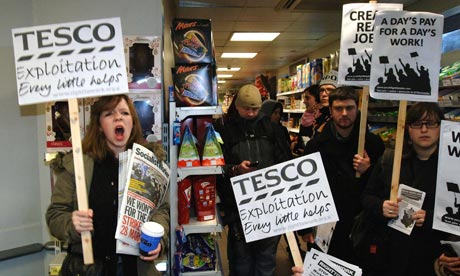
The answer is simple ..they will not participate in the scheme, the companies thought that despite of it not actually helping them in real terms, that they might get a bit of PR boost for providing the opportunities ...however with that out the window, they are pulling out and fast. Tesco have said they will start paying people and will give people jobs at the end of the placements unless there is a reason not to.

It is very important to actually read that statement with a business head on. Tesco's will not be taking on more people than they need, so whereas they used to grant placements to a large amount of VOLUNTEERS, that number will be shrinking.

Well done everyone, you have succeeded in taking away placements that actually have waiting lists because so many people WANTED to get on them out of uninformed misdirected anger.

I take it you'll be off to shut down the soup kitchens now for not paying their 'slaves' serving the food?


Wednesday, 31 August 2011

Twitter Vs Strawman / Dorries

It is rare that I find myself in agreement with the majority of Twitterettes and Twitterinos, so was not unsurprised that I found myself on the wrong side of the herd view, what did surprise me was the ratio.

In a very unscientific analysis of the hashtag, I found only one other poster that agreed with me.

The subject of course is Nadine #Dorries and her proposed amendments in reference to abortion.

Now I understand that many people dislike Dorries so even taking this into account, (That people will say the sky is pink if she says it is blue) I am surprised by the opposition on a couple of parts of what she says.

Opinion One, that any organisation that benefits financially from a particular outcome, should not be classed as independent, when it comes to whether that outcome is taken or not.

That is common sense, isn’t it?

Someone tried comparing it to the RSPCA somehow, saying that ‘Stopes’ having a vested interest in abortion is the same as the RSPCA having a vested interest in cruelty.

That is a bit of a strange comparison on a couple of fronts. 

Firstly, the RSPCA would make more money by NOT treating animals; just sending them away, would be easier than operating etc.

Secondly, it is suggesting that the choice between abortion or not abortion is similar in context to animal suffering or non-suffering.

There is an automatic assumption that the only people allowed to give advice will be religious fundamentalists though Ms Dorries has said “This won’t be offered by any religion-affiliated groups, but by the British Association for Counselling and Psychotherapy”1

So unless the BACP have suddenly become religious zealots, I am a bit unsure what the cause of this ‘Straw-man’ nonsense is.

As an atheist and anti-theist I have no enthusiasm for practical decisions to be made in relation to mythological belief, but this is not the only alternative so it is misleading for it to be framed in such an either/or way.


Her second opinion which has upset people, but has been less (a little less) vilified is her opinion that the upper timescale limit of 6 lunar months should be reduced to 5. i.e. 24 weeks to 20.

This apparently makes her ‘evil’.

When I asked why this would be the case I am often ignored.

Her is my research on the subject, and please keep in mind I have no axe to grind, I am pro-choice, I have no moral objection to the idea of pregnancy termination.

According to meta-analysis cited by SpensersHope.org, up to 70% of pre-mature births at 24 weeks can survive; published articles in medical journals put this figure more conservatively at 39%-50%.

These figures alone are quit worrying, now consider that these are where pre-mature birth is caused for a whole range of different reasons, a lot of them to do with the health of the mother and/or baby which would increase the chance of mortality, and you can imagine the levels of survival from babies about to be aborted at a much higher level.

I am all for personal freedoms, I am a libertarian and consider personal liberty paramount but with one very big exception. The acts of a person should never take away someone else’s freedom or life and it is quite evident that life is indeed being taken away in some of these late term pregnancies.

Again, I feel I need to stress that I am NOT an anti-abortionist, but for me what happens to fetuses is abortion, what happens to babies is murder and when something is alive in its own right, it is a baby not a fetus.

Let the vitriol attacks begin 


Thursday, 19 May 2011

-Interruption to normal service- Rape being rape is rape, but not all rapes are the same

Hello people,
                    Slight change of pace and subject I know, but this subject has sucked so much of my time because I cannot bare uninformed or over-zealous arguments to beat down intelligent, rational comments.
Firstly, let's start with Slut Walk.
I have devoted a bit of my time trying to figure this out. I have spoken to many different women in support of it, some fanatically, some more sensibly.
My conclusion is that it is a misguided and pointless march.
Interestingly, unlike most causes that start with good and intelligent intentions but run the risk of being hi-jacked by irrational forces, Slutwalk has been the opposite.

Slutwalk was sparked by a Policeman in Canada making some rather blunt and politically incorrect comments. The exact wording changes depending on who you speak to and to what degree they are trying to use the policeman as a reason for the march, but the jist is 'girls should avoid dressing like sluts to help avoid being victimised'.
At it's heart, this is a sad but probably true comment on society.
The biggest obstacle we come up against is information, as so many rapes are unreported also a great number of rapes reported are found not guilty and a great number of rapes that are both reported and convicted (so count towards the figures) are committed by relatives or people where the target is not randomly selected, so 'stranger' rape is quite rare to have statistics on it either way.
However, this is where common sense comes into play.
Most people will say that if you walk through a bad neighbourhood alone with a Rolex on and draw attention to it, you will increase your chance of robbery. This is quite accepted, it is not shifting blame, it's not saying that the victim deserved it, it is purely a statement on statistics.

I have asked a more relevant question to the debate, which woman is more likely to be attacked, Woman A or Woman B where Woman A is with a group of friends and relatively sober and Woman B is lying passed out in an alley with her skirt pulled up.
Chances are statistically small that either woman will be attacked, but in comparison to each other, there would be, I imagine, a hugely increased risk to Woman B. Again, this is not talking about blame as fault is not implied with statistical analysis.
To bring it closer to the offending statement. A woman that has gone to the effort of making themselves attractive and sexual will likely increase the chance of people being attracted to her sexually and with increased attention, the likelihood of a bad type of attention from verbal harassment, pinching of girls bums also increases.

The choice of words may well have been objectionable, but this was, by the sounds of  most accounts, an off the record,throw away comment by someone that is probably a lot more familiar with the subject, seeing as he has to deal with it on a day to day basis, than most of us (thankfully) that is probably logically true even if it is a terrible truth.
This is not a basis for a international march.

Other reasons given

Reclaiming the word slut (slut is an insult and will always be one..used just as much by women to describe other women than by men. There is no need to reclaim it..just don't use it)

Highlighting 'Rape is wrong' (now to me the fact that rape carries a custody sentence as a minimum in most cases and can be 'life' ..I am quite sure rape is acknowledged to be wrong already..except perhaps by rapists, but let's be honest, a group of angry women are unlikely to change their mind)

Combat victim blaming (this is the reason I said was the sensible cause that is trying to hi-jack the irrational core. Victim blaming is wrong and nearly everyone except the really foul fringes of our communities agree. Let's be clear here, there is a HUGE gulf between saying refraining from certain actions can statistically lower risk and saying that if you don't refrain from certain actions you DESERVE the outcome. One is statistical analysis, the other is victim blaming and is unacceptable)


The problem is, this last idea, the hastily added extra by women who want to get angry about something and go on a march but require rational reasoning, for me is too far removed from the core and often leads to the mistake I clarified above between talking about likelihood and how much someone deserves actions against them.

 The second part of the article deals with the comments of Ken Clarke.

A similar over-reaction to sensible comments on a controversial subject. He said nothing that isn't understood by anyone working in the law profession or in fact any other objective person.

Let's firstly deal with the definition of rape in the UK's court process, which is a lot stricter than many country's.

Rape is the non-consensual act of sex performed on an unwilling participant.

The concept of consent is quite blurry in UK law too. For example, a 15 year old is below the age of consent, but if it is mutually agreed, it doesn't class as rape, it is unlawful sexual intercourse or U.S.I. Only at 12 yrs or younger is mutually agreed but non-consensual (due to not being seen as fit to consent) sex considered rape, even if committed by someone of the same age..or younger in the case of a male.

Other countries don't have this complication and consider statutory rape (sex below the age of consent at any age) as rape.

Mutually agreed sex can also be considered rape in the case of adults if one of the parties later decides they weren't fit to consent, even if they initiated and carried out the act.

Say for example we have a Boy -B and a Girl - G.

B and G meet at a party, both are drunk, perhaps B even a little more so.
As the evening draws on, things become sexual and G asks B to go somewhere private with her. B obliges.
G performs a sex act on A and initiates intercourse with B.
After the deed, they lay together in bed, and after a while leave the party to go to their respective homes.

In the morning G wakes up and decides that if she was sober she wouldn't have gone all the way with B on the first 'date'. In other words G has decided due to alcohol, she was unfit to consent. At this point the exchange above becomes rape by law.

I am not here to argue the wrongs or rights of that. However if you look at this objectively, you can see how this crime does not deserve life imprisonment for B, which is the possible sentence he could have faced had he abducted G, threatened her with a weapon and violently had forceful sex with her.

I'd like to think that anyone thinking about this objectively will see this. This is what Ken Clarke said, he also said the first example of rape , i.e. date rape as we would understand can be as serious as the second example in some instances, for example had B specifically medicated G in order to have sex with her that he knew G would not consent to.

The whole 'Rape is rape' argument is misleading because it can mean any different things to different people. Logically rape is of course rape otherwise it wouldn't be called rape, but it is often meant to suggest that there are no differences in the severity of rape. This I hope we have dis-spelled but further evidence is the amount of trauma that the victims go through.

Now I am quite sure the number of people that regret a drunken fumble is quite high and the amount of times this can involve penetration is almost equally high, but I doubt many people would claim their trauma caused from this is equal to that of a forcefully raped victim. It would be interesting to pair the latter with the former and ask the latter's opinion.

Key Points
Blame never lies with the victim in any crime
Rape is rape but not all rapes are equal in severity or seriousness evidenced by trauma caused and circumstances.
Political capital can often be made to try to twist words of sensible people


Hopefully this will be the last time I need to deal with this terrible subject, but I think it's important we don't let the highly emotional subject matter to lead to us losing our rationality.

Saturday, 14 May 2011

Rally Day!

Hello Dearest Chums,
                            Just sitting down after getting back from the 'Rally Against Debt'.
Must say it has had quite a bit of attention on the news as well as the social networking sites and despite the less than ideal travel, I had a really good time.

From suits to sweats, ordinary people from all walks of life attending 'Rally Against Debt'


I decided to use my time wisely there, I met a number of fellow twitter users, I kept an eye on the treatment of the Parody protesters, which rather predictably are being touted by their own as examples of the 'Craziness' of our movement (pushing the straw man argument to it's very extreme by actually being it's own straw man). I spoke to a couple of the policemen (think I counted 14 odd)  who I asked if they had been especially called in to police the rally, and I must admit he had a slight smile on his face when he said no, they were all on duty anyway but instead of being on call driving around, they were on call from there.


Steward finding controlling the radical's are self-regulating (spot the twitter user)


At 12'O Clock the speeches began..which considering we were standing pretty much next to Big Ben were almost instantly drowned out by the bells. My highlights were Mr Durkin and Mr Farage..which shows you how bi-partisan it felt as there WAS a Tory for me to pick too .

Some of the speakers..
Paul Staines (Guido Fawkes), political blogger  (Order-Order)
Mark Littlewood, Director of the IEA (Institute of Economic Affairs)
Matthew Sinclair, Director of the TaxPayers’ Alliance
Martin Durkin, documentary film maker and activist


I think an important organisational note should be the need for a bigger PA system next time (oh yes, this is only the beginning!) as the excessive noise of London traffic made some of the more eloquent speakers hard to hear, it's a lot easier to hear innane guttural screams of "F*ck the Cuts!" than it is to hear excellently delivered criticisms of the slavery called debt.
Still, I'm sure we all appreciated the toots and thumbs up from passing traffic.

A lot was said about the demographics likely to be at the rally and I think it prudent for me to honest and as objective as I can be. The numbers, firstly ( quite fittingly considering the subject matter) weren't as good as I had hoped for, I would say that there were somewhere between 350-400 people with perhaps 15-20 of those seeming to be press of some type or the other.


  ...Sorry Neville, you will insist on blinking


Now while this initially made me sigh, as soon as I started talking to the attendants all was forgotten, and as was pointed out by one of the speakers, our placards weren't in the same mood as the TUC march..there were no "F**k off Socialist scum" or "Labour Pr*cks" placards that would have been the mirror of the TUC march placards. In fact a lot of the TUC banners "Capitalism isn't working" for example would have been more fitting at this rally but corrected to actually critique the system that failed us. "Socialism isn't working"...perhaps  there was a double entendre joke there we could have used (I was myself wearing a "The problem with Socialism, is that you eventually run out of other people's money" Thatcher T-Shirt).
PS My favourite placard "Go stimulate yourself!"


Hayek' splosive Interview (sorry)

The people were from all over the country, some would look quite at home with a shotgun screaming at you to get off their land, some of them looked like they normally wore berets, there were different accents from all over the UK and a lot of people that travelled a lot further than I did!
In short, this was no rich person's rally, it was no young person's rally, it was no middle class rally, it was a rally from and of the people, who have nothing to gain from a successful outcome except the chance to pay their own bill, and have a bit of say in what was put on the shopping list.

All pleasant people, very friendly..and even Old Holborn was smiling...I think..though he was towering over a burning Euro flag...enough to make most smile.


We don't want poor people to get poorer, economic interference does that and that is what we are campaigning against.
We want all working people to benefit from what they do and to reintroduce supply and demand. At the moment we are supplied what the government deems is right for us and have the cost added to the bill.

We do not need diversity co-ordinators, we as a species, have been diverse for long enough without needing it co-ordinating. We do not need the thick layer of bureaucracy feeding off the hard working people of the country.What we do need is to stand up to the politicians bribing us with our own (and our children's) money and tell them enough is enough.

Today we made a start. This is just the beginning and eventually the majority of people who pride themselves on paying their own way will be with us. Then the politicians will finally have to learn that our freedom, and that of our children and our children's children cannot be bought.We will not surrender ourselves for the circuses and bread being offered.


*The scandal that is publicly funded union representatives was also brought up, this isn't anything new but will be brought before parliament soon, so if you can spare the time, write to your MP and tell them that Nurses should be Nurses, Firemen should be Firemen and unions who are very well funded as it is, should be unions.


ALL PHOTOS

Wednesday, 11 May 2011

Where's the sense in paying more for less UKuncut?

A report from the IFS looked at public spending between 1997 and 2010 pre election last year.

In it, as you can imagine, it shows that the growth of spend on public services, rose tremendously under the Labour government. This shouldn’t surprise anyone that has looked at the figures, but I think it best we look at it in more detail and quantify it before moving on.

In 1997 when Labour was elected, as a percent of national income, spending on public services was 39.9%, when Labour left office it was 48.1%.

The growth in real terms of this spend is 4.4% year on year. Under the Conservatives between 1979 and 1997 the figure was 0.7%.


 So we can safely say that we are spending a lot more on services than we were.

Out of the 28 countries that we have comparable figures from we went from 7th lowest spend on percent of National income to the 6th, in 2010. This represents the biggest % jump out of all the 28 countries,


“… BUT” I hear you cry “we had to bail out the banks”. Yes, we did. So if you like, we’ll look at the figures from 1997 to 2007, a year before the recession. Our % increase spend was the 2nd largest out of the 28.


I think we can safely say we have established that we have spent more, however this isn’t necessarily a bad thing. I spend more at the supermarket sometimes too, especially if there is an offer, because although my weekly spend has gone up, I normally walk away with a bigger increase of value to money spent, or ‘Bang for buck’ as the calculator jockies call it.

So, did things get better proportionally to our increased spend?
Well, our public services have got better, the social security funds and eligibility for them have grown almost every year since the end of the war, this is a good thing, but has it got 8.2% better?

The ONS aimed to calculate this based on output figures and input figures from 1997 to 2007. They found that the ‘bang for buck’ had actually gone down by 13.4%.
In other words if efficiency and productivity had remained at the levels in 1997, for the extra money injected into the system, we should have had a 15.5% bigger output.

Philip Hammond doing a similar comparison, this time in ‘bang for buck’ growth in the Private Sector VS Public Sector concluded that the same services, if 1997 levels of efficiency were kept, should have cost £60 billion less than it actually did (if you compare it strictly Public Sector VS Public Sector we would have benefitted from the same output but for £42.5 billion less).
ONS Graph


So I think it is very important we keep this in mind before we go barrelling off to stand still in front of a shop we believe should pay more tax than it has to by law and the like UKuncut style. What really is the point in protesting over a few 10’s of £million’s when we have a £60 billion a year short fall on services as it is?

Surely all that is doing is throwing more money at an obviously failing system.
Firstly, let us address all the reasons why £1’s worth of spending on public services does not equal £1 of ‘bang’. Until then all we are doing is becoming ‘busy fools’ with a lot of input and not much more to show for it.

Somewhere in the public purse, there is a hole, no matter how much money you throw at it, even if you ignored the huge risk in scaring away the top 1% who pay for 25% of all tax, the extra money doesn’t give you the correct value.

We need to cut this out of the public services system, if that means jobs, then I am afraid that is what is needed. The public sector is not a charity and cannot afford to keep them bloated for the sake of it.

We need to get our house in order before we invite extra guests.

When we achieve that, you may find me calling for Tesco’s to pay an extra £60 million a year on top of the billions paid already, until then those actions seem quite pointless.

I would encourage UKuncut to treat each waste of our money on a level playing field instead of cherry picking which bit of lost money is a good loss and which is bad loss.

Anyone striving for a better, efficient country should be at the Rally Against Debt on the 14th of May.


Sunday, 8 May 2011

Why I support 'Rally against Debt'

For most of you that are on Twitter or Facebook you may have come across #RallyagainstDebt before.

This post will be used to introduce it to you if you haven't already and will be a brief explanation of why it has my 100% support.

On the 26th of March, I like many in the UK was sat at home, little did I know that while most people were at home, at work, at the zoo or booking a day out to a pirate exhibition, we were apparently also supporting the 'March for The Alternative'.

I found this out when reading lefter-than-Lenin's-left-sock newspapers and news reports telling me that it was a view held by the majority of Britons...and good ole Red Ed Miliband told me that if I opposed the march that I ...er, supported apartheid? Hmm..this went too far for even the action loving press.

I could not reconcile this, however with the fact that most people that I tutted to about the march didn't even seem aware of it's existence.

The newspaper reports were  'proved' by a poll by YouGov.

Total sample size was 2,720 adults and was asked online.


                                            Total  
            Conservative  
                     Labour         
         Liberal Democrat
Support
52
19
83
40
Oppose
31
66
9
43
Don't know
17
15
8
17


The first thing you will notice is that you are only likely to support the March if you're a Labour supporter..if you look at the General Election '10 results you will see that you are statistically not likely to be a Labour supporter.

Not a surprise that a lot of Labour people were supporting the March, officially it is a TUC march and secondly it is a march against the actions that were taken to fix the problems inherited by Labour. It would be political suicide to NOT back it if you're the Labour leader because you would pretty much be saying "Yes, sorry guys, all these things that are being cut...that is to pay for OUR faults".

Anyway, enough back story. It was at this point that Rally Against Debt was dreamt up I believe. With the simple premise that yes, of course if there was a way to fix everything without every having to take responsibility that would be the most popular order of the day (this is why the the March for the Alternative was well attended, promoting new taxes like the Robin Hood tax, which even if it went well has no scope for fixing any problems even by its own advocate's figures and a clamp down on Tax planning methods..all ways by the public that can help them escape any need for austerity).

Coincidentally (smirk), a lot of the marchers had financial interest in the public sector not being cut. From the workers who benefit from a bigger salary and better pensions on average than their private sector brethren and the unions themselves that feed off of them. However, it did seem to have escape people's minds. I doubt that this would be allowed to go unmentioned if the banking sector ripped through London on a  'Bankers against the Banking Levy' march...but that is the mentality I guess, it's only greed when other people do it.

One thing should be noted and I think should be widely agreed before we continue. The public sector is too big. That is a fact. 'Whether we should cut it now, instead of keeping it too big in order to try and kick start growth' is the question, not 'is it too big?'.
That is mathematical, not ideological.

The amount of people in interviews who started by saying that the public sector wasn't too big had me sighing deeply, they don't even know why they are there. Even their beloved Labour party were going to cut back the public sector and when Labour are planning on cutting the public sector, that is a good indication that it has ballooned FAR beyond what is efficient.

I will not mention blame for this problem by Party from this point on, because it doesn't really change what our options are. It doesn't make a blind bit of difference which party ran up the debt or presided over the problems, the problems are here and we need to fix them.

Let's start off our thought process slightly differently.
What is economic growth? and is it always a good thing?
Growth is the expansion of GDP, is the common answer..however I do not see that as an accurate way to describe it. This doesn't take into account the reason for a higher GDP.

To bring it into loose terms that could be understood easier. GDP is like the value of all your possessions, your home, car, bank balance and furnishings. It is presumed that that any growth in the value of these things is a good thing.
What we do not consider though is the difference in growth because you spent wages ...or borrowed to buy goods.

This makes a crucial difference.
If we use our wages for it, it is sustainable, yes, we may have cash flow troubles sometimes, but as we are not committed to future liabilities, we are safe.

If, on the other hand, we use all our wages, but in an attempt to 'grow' our assets decide to get a loan using our friends as guarantors on the loan, this is very different. Firstly, our assets value will never grow by the amount we spend, that is the nature of commodities, there will always be value lost in the process of manufacturing them in labour costs and profit, meaning in affect, our £500 TV is made up of £250 worth of assets.

This is not normally a problem if spending your own money, but if its borrowed, it means that the value of your item is less than the loan, PLUS you will need to pay interest on the loan.*

*Real World- It has been shown that for every £1 borrowed and spent to encourage growth, it succeeds in growing the economy by 30p, and as that pound is borrowed, we pay back closer £1.05 to get 30p worth of growth.

The best option in our analogy would be to A) increase our REAL income or B) make efficiency savings (or both, which is what the current government are trying to do)
Neither of these options increase our asset value as much as borrowing but it is real and not tampered with.

However, what we had before the crash was a high growth, powered by the dynamo of credit. Sooner or later this had to stop and it caused just as much trouble as the boom had caused success. Economics has a way of balancing itself like that.

I would suggest that, excluding an event of Industrial revolution scope, we should ALWAYS fear the line on the graph steeply going up just as much as the steep decline, the later is caused by the former in most cases.

To suggest that we should start this cycle off again after we are still struggling from the last is ludicrous, but that is what is being demanded. Yes, they suggest sources for this money, but as discussed briefly, they are very unrealistic and even when achievable are so ineffective that the nature of the game doesn't change.
They are asking the country to take on debt to pay for the current spending, with the add-on line of "So it kick starts the economy".

This brings together their two reasons for fighting the cuts, they don't want to suffer cuts themselves and they do not see the problem with artificial growth. Not the strongest position.

What I believe in is real organic growth, based on more produce at same cost / same produce at less cost and/or new markets. The other concept I believe in is self-responsibility. By suggesting we borrow against our future tax income, we are getting something for nothing. The future generations that have to pay it off will be getting nothing for something ( a something bigger than what we received too!).

I cannot do this in good conscience, I cannot sit back and let the overly optomistic, who benefit in the short term on the gamble that over-spending might solve our problems, go unopposed.

I strongly agree with the sentiment of the following quote

"we do not inherit the earth from our ancestors, we borrow it from our children"

This may not be our mess (another article is to come on the cause of our current situation), but either we clean it up, or our children do. That is the only choice..and the cleaning method has to work!

Support 'Rally against Debt', a fair, honest and most importantly, realistic alternative to pretending 'boom and bust' do not exist.

Tell us why YOU support Rally against Debt by emailing the organisers here

Visit the website at http://rallyagainstdebt.org/ and Facebook page to get more info on the first Rally on the 14th of May in London (say hi if you see me).
Alternatively, follow the #rallyagainstdebt or #rad hashtag and @debtrally.

And me, obviously @DBirkin